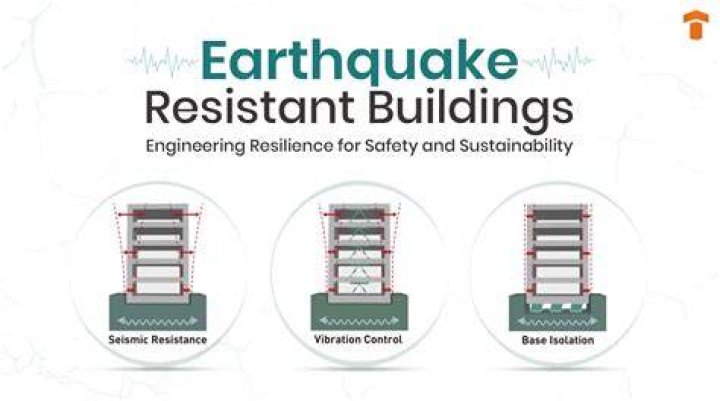
Most buildings in California’s earthquake country are designed to be earthquake safe. Skyscrapers and other large structures built on soft ground must be anchored to bedrock, even if it lies hundreds of meters below the ground surface. The correct building materials must be used. Houses should bend and sway.
What types of buildings are susceptible to earthquakes?
Some of the most susceptible structures to shaking damage are soft-story apartments and condominiums. A soft-story residential building is one that has large openings on the first floor for garage doors and windows to accommodate parking or commercial space, and housing on upper floors, built prior to recent codes.
What type of houses should be built in seismic zones?
Answer: In earthquake-prone zones, to make the homes earthquake-resistant, keep the walls and the partitions light. Constructing thin concrete floors also helps. On the other hand, a well-built and properly designed Reinforced Cement Concrete or RCC structure undergoes a ductile failure.
What should you consider in building a house near a fault line?
Phivolcs now recommends avoiding construction within 5 meters on each side of a fault trace, or a total width of 10 meters. We may call this the ideal “10-meter wide no-build zone” in the vicinity of a fault. Ideally, we should not build in the 10-meter wide no-build zone to avoid the hazard of ground fissure.
How can you stay safe in an area with tectonic activity?
In most situations, you can protect yourself if you immediately:
- DROP down onto your hands and knees before the earthquake knocks you down.
- COVER your head and neck (and your entire body if possible) underneath a sturdy table or desk.
- HOLD ON to your shelter (or to your head and neck) until the shaking stops.
Can a building collapse from earthquake?
Concrete buildings University of California researchers estimate that about 75 of the nearly 1,500 buildings on the list could collapse in a large earthquake, exposing thousands to injury or death.
How do you know if a building is earthquake resistant?
Visual check
- Deep cracks between slab and beams.
- Continuous deep cracks in roofs.
- High vibrations while moving a furniture or running on the floor.
- Visible continuous cracks in the basement columns and retaining walls.
What makes a house earthquake proof?
To withstand collapse, buildings need to redistribute the forces that travel through them during a seismic event. Shear walls, cross braces, diaphragms, and moment-resisting frames are central to reinforcing a building. Made of panels, these walls help a building keep its shape during movement.
How far from house is safe from fault?
But first, what is considered a safe distance from a fault line? PhiVolcs recommends avoiding construction within five meters on each side of a fault trace. This is equivalent to a total width of 10 meters. This is considered the ideal “10-meter wide no-build zone” in the vicinity of a fault.
What do you mean by a building code?
A building code is a set of regulations that are enacted by either state or local governments regulating the construction, renovation and repair of buildings and other structures that humans may occupy. We use the term ordinance to describe a regulation passed by a municipality, such as a city, village or town.
What are the regulations for building a building?
The regulations apply to most new buildings and many alterations to existing buildings . A series of approved documents provide general guidance on how specific aspects of building design and construction can comply with the Building Regulations . The requirements are set out in Schedule 1 of the regulations :
What are residential buildings as per NBC guidelines?
What are residential buildings as per NBC? The National Building Code (NBC) is a document that provides guidelines for construction of structures – residential, mercantile, institutional, educational, commercial, assembly, storage spaces or even hazardous buildings.
What does the National Building Code ( NBC ) mean?
The National Building Code (NBC) is a document that provides guidelines for construction of structures – residential, mercantile, institutional, educational, commercial, assembly, storage spaces or even hazardous buildings.