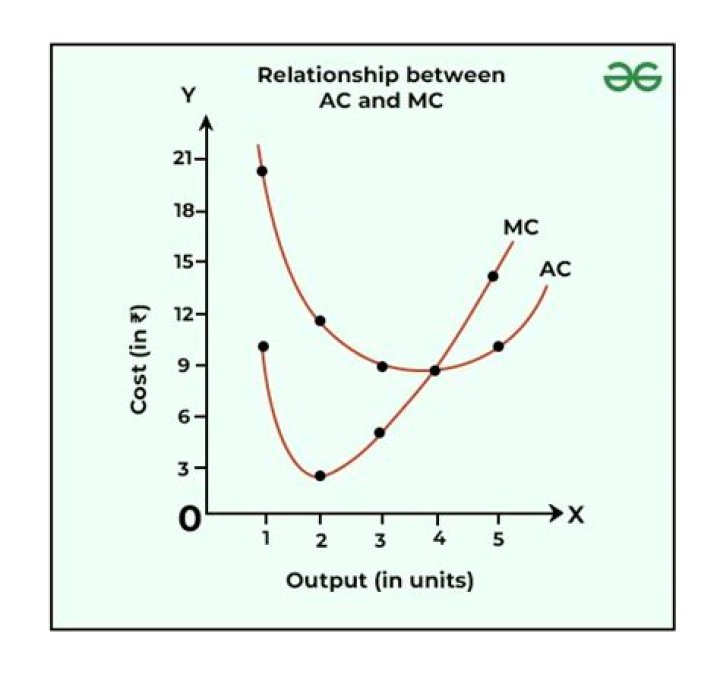
Average cost is obtained by dividing total cost by the number of units produced. Marginal cost is the cost of producing one additional unit of output. The total cost, in this reference, is the sum total of the total fixed cost plus total variable cost at a given level of output.
Is average cost same as average product?
Therefore, AVC is inversely related to AP, i.e., when AP increases, AVC decreases….Relationship between average variable cost and average product.
| Marginal Product | Marginal Cost |
|---|---|
| Decreasing | Increasing |
What is the relationship between total product and average product?
It refers to the total amount of output that a firm produces within a given period, utilising given inputs. It is output per unit of inputs of variable factors. Average Product (AP)= Total Product (TP)/ Labour (L). It denotes the addition of variable factor to total product.
What is the difference between marginal product and average product?
Marginal product is the increase in total product as a result of adding one more unit of input. Average product is the total product (or total output) divided by the quantity of inputs used to produce that total.
Is production function and cost function related?
Production function: Relates physical output of a production process to physical inputs or factors of production. marginal cost: The increase in cost that accompanies a unit increase in output; the partial derivative of the cost function with respect to output.
How to calculate total product and average product?
Thus, it can also be said that Total Product is the summation of Marginal products at different input levels. Average Product. It is defined as the output per unit of factor inputs or the average of the total product per unit of input and can be calculated by dividing the Total Product by the inputs (variable factors).
What is the relationship between average product and marginal product?
Relationship between Average Product and Marginal Product. There exists an interesting relationship between Average Product and Marginal Product. We can summarize it as under: When Average Product is rising, Marginal Product lies above Average Product. When Average Product is declining, Marginal Product lies below Average Product.
What makes up the average cost and output?
Average total cost and output. Average cost, consists of average fixed costs and average variable costs. As we see, average fixed costs begin to fall with an increase output while average variable costs come down and rise.
How to calculate average fixed cost, average variable cost and average total cost?
Average total cost (ATC) is obtained by dividing the total cost (TC) by the quantity of output (Q). Or alternatively, it can also be obtained by adding Average fixed Cost (AFC) and Average Variable Cost (AVC) Diagrammatically the vertical summation of average fixed cost and average variable cost curves gives us the average total cost curve.