The term “Levels of Management’ refers to a line of demarcation between various managerial positions in an organization. The level of management determines a chain of command, the amount of authority & status enjoyed by any managerial position.
What is a Level 1 manager?
Level 1 of the Management Skills Pyramid shows the basic skills a manager must master to ensure the work of the organization is completed at the right pace, quality, and cost.
What are the composition of managerial level?
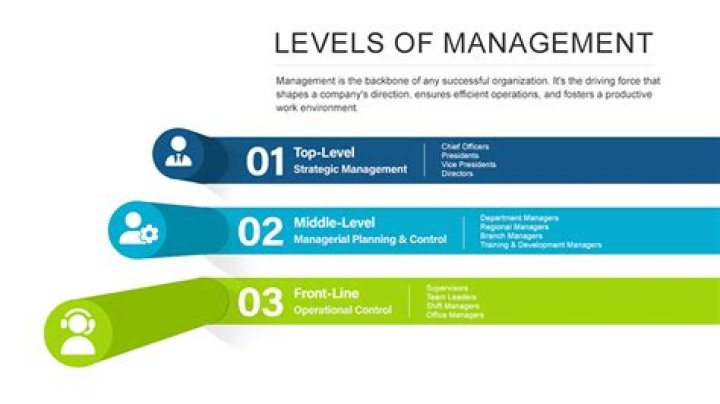
Most organizations have three management levels: first-level, middle-level, and top-level managers. These managers are classified according to a hierarchy of authority and perform different tasks. In many organizations, the number of managers in each level gives the organization a pyramid structure.
What are the 3 level of management?
The 3 Different Levels of Management
- Administrative, Managerial, or Top Level of Management. This level of management consists of an organization’s board of directors and the chief executive or managing director.
- Executive or Middle Level of Management.
- Supervisory, Operative, or Lower Level of Management.
What are the two types of managers?
The Assumptions of Douglas McGregor McGregor proposed that there were two types of managers: ones who assumed a negative view of their employees, also known as the Theory X managers, and others who assumed a positive view of workers, or the Theory Y managers.
What is a Level 5 Leadership?
Level 5 leadership is a concept developed in the book Good to Great. Level 5 leaders display a powerful mixture of personal humility and indomitable will. They’re incredibly ambitious, but their ambition is first and foremost for the cause, for the organization and its purpose, not themselves.
Managers have formal authority to use organizational resources and to make decisions. In organizations, there are typically three levels of management: top-level, middle-level, and first-level. These three main levels of managers form a hierarchy, in which they are ranked in order of importance.
What is managerial level system?
Management-level systems serve the monitoring, controlling, decision-making, and administrative activities of middle managers. Some management-level systems support nonroutine decision making. They tend to focus on less-structured decisions for which information requirements are not always clear.
What are the 5 levels of management?
The 5 Levels of Leadership:
- Level 1: Position. This is the lowest level of leadership—the entry level.
- Level 2 – Permission. Making the shift from Position to Permission brings a person’s first real step into leadership.
- Level 3: Production.
- Level 4: People Development.
- Level 5: The Pinnacle.
What is the first level of management?
First-line managers are the entry level of management, the individuals “on the line” and in the closest contact with the workers. They are directly responsible for making sure that organizational objectives and plans are implemented effectively.
What are the responsibilities of the managerial level?
Each level has a different area of managerial responsibility and reporting structure. These are the highest level of managers within an organization, and they are tasked with setting organizational objectives and goals.
What are the different levels of Management in a company?
Levels of Management 1 Top Level of Management It consists of board of directors, chief executive or managing director. 2 Middle Level of Management The branch managers and departmental managers constitute middle level. 3 Lower Level of Management Lower level is also known as supervisory / operative level of management. …
Which is the best description of lower level management?
Require more managerial and technical skills and less conceptual skills. The lower level management consists of the Foremen and the Supervisors. They are selected by the middle level management. It is also called Operative / Supervisory level or First Line of Management. Lower level management directs the workers / employees.
What’s the difference between top and middle level managers?
A number of aspects of the management process differ within the hierarchy. The importance of each of the functions of management differs from one managerial level to another. a. Planning tends to be more important for top-level managers. b. Organizing tends to be more important for both top and middle-level managers.