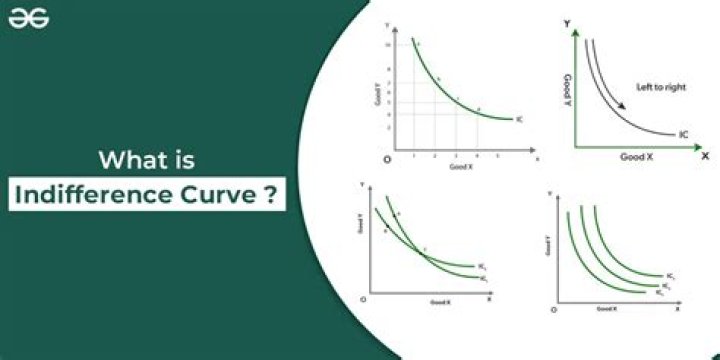
Definition: An indifference curve is a graph showing combination of two goods that give the consumer equal satisfaction and utility. Each point on an indifference curve indicates that a consumer is indifferent between the two and all points give him the same utility.
What is indifference curve explain characteristics?
The very important feature of the indifference curves is that they are convex to the origin and they cannot be concave to the origin. A normal indifference curve will be convex to the origin and it cannot be concave. The consumer passes from point A to B on the same curve to remain in the same level of satisfaction.
What is indifference curve with examples?
An indifference curve shows all combinations of goods that provide an equal level of utility or satisfaction. For example, Figure 1 presents three indifference curves that represent Lilly’s preferences for the tradeoffs that she faces in her two main relaxation activities: eating doughnuts and reading paperback books.
What is indifference curve analysis Analyse the properties of indifference curve technique?
The indifference curve analysis measures utility ordinally. It explains consumer behaviour in terms of his preferences or rankings for different combinations of two goods, say X and Y. The latter shows the various combinations of the two commodities such that the consumer is indifferent to those combinations.
What are the types of indifference curve?
Indifference curves for normal goods, substitutes and perfect complements.
What are the applications of indifference curve analysis?
The indifference curve analysis has also been used to explain producer’s equilibrium, the problems of exchange, rationing, taxation, supply of labour, welfare economics and a host of other problems. Some of the important problems are explained below with the help of this technique.
What are the five properties of indifference curve?
5 Most Important Properties of Indifference Curves
- (1) Indifference Curves Slope Downward from Left to Right:
- (2) Indifference Curves are Convex to Origin:
- (3) Two Indifference Curves cannot Touch or Intersect Each Other:
- (4) Higher Indifference Curves Represent Higher Level of Satisfaction:
What is the importance of indifference curve?
Some of the advantages are: 1. It Dispenses with Cardinal Measurement of Utility 2. It Studies Combinations of Two Goods Instead of One Good 3. It Provides a Better Classification of Goods into Substitutes and Complements and Others.
Why do we need indifference curve?
Most economic textbooks build upon indifference curves to introduce the optimal choice of goods for any consumer based on that consumer’s income. Classic analysis suggests that the optimal consumption bundle takes place at the point where a consumer’s indifference curve is tangent with their budget constraint.
What are the limitations of indifference curve analysis?
(ii) Indifference curve analysis assumes that consumers are familiar with their preference schedules. But, it is not possible for a consumer to have a complete knowledge of all the combinations of the two commodities, total satisfactions from them, rates of substitutions and total incomes.
How is the indifference curve used in economics?
There is an extremely useful tool to facilitate the analysis of the consequences of price variations. This tool is known as the indifference curves. Hence, providing the different combinations of goods that provide the same level of utility or satisfaction to an individual. This is the theme we developed today in our concepts of Economics.
Why does an indifference curve reflect constant level of utility?
Because each bundle of goods yields the same level of utility, the consumer is indifferent about which combination is actually consumed. Combinations of goods along an indifference curve reflect some constant, though unspecified, level of utility.
Why is an indifference curve cannot be vertical?
Similarly, an indifference curve cannot be vertical as shown in the figure, as in point D, the consumer gets more of y commodity than at point C, B or A while the x commodity remains constant; so the consumer cannot be indifferent to various combinations as they denote different satisfactions.
Why is the indifference curve called the ordinal approach?
Thus, this theory is also known as ordinal approach. An indifference curve is a locus of all combinations of two goods which yield the same level of satisfaction (utility) to the consumers. Since any combination of the two goods on an indifference curve gives equal level of satisfaction, the consumer is indifferent to any combination he consumes.