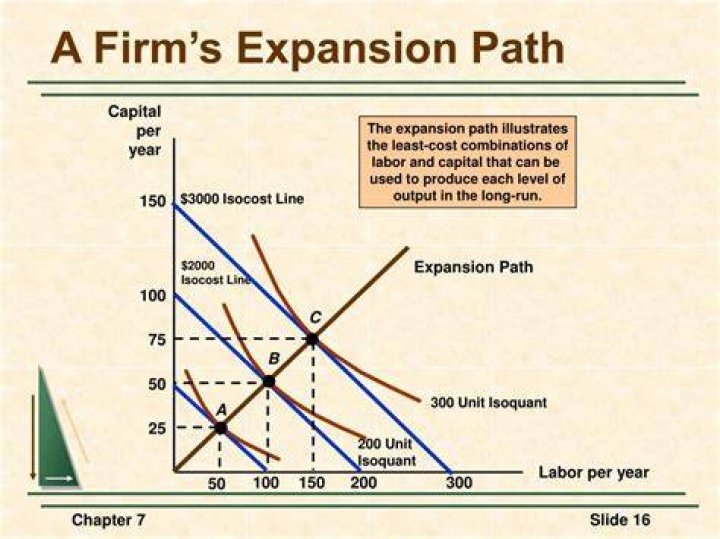
First, it may want to expand by successively increasing its level of cost or its expenditure on the inputs X and Y, i.e., by using more and more of inputs, and, consequently, by producing more of its output. Second, the firm may decide to expand by increasing its level of output per period.
What is the income expansion path?
The income expansion path (also called income consumption curve, IEP) is a graph that shows how different income affects consumption of two different products. To find the income expansion path, you find the consumer’s optimum of each budget constraint and draw a curve to connect the consumer’s optimums together.
What is ridge line and expansion path?
The expansion path is also. an isocline that connects the least cost combinations of inputs for all yield levels. On expansion. path, the marginal rate of substitution must equal the input price ratio: Ridge lines represent the limits of the economic relevance, the boundaries beyond which the.
What is a long run expansion path?
The Long-Run Expansion Path Suppose the firm’s production function gives it constant returns to scale (need a review?). It is referred to as the firm’s long-run expansion path (LREP). It shows the cheapest cost of raising output in the long run.
What is expansion curve?
(Steam engine) a curve the coördinates of which show the relation between the pressure and volume of expanding gas or vapor; esp. (Steam engine), that part of an indicator diagram which shows the declining pressure of the steam as it expands in the cylinder.
What is short run expansion path?
The short-run expansion path (SREP) illustrates the minimum cost of increasing output in the short run. Because the isocost line C1 lies above the point of tangency with isoquant Q1 , we can see that even this minimum short run cost is more expensive than the minimum cost possible in the long run.
How do you find the expansion path of an equation?
and the input prices are rx = Rs 10 and rY = Rs 5. ADVERTISEMENTS: Equation (3) is the required equation of the expansion path. It is evident from the form of the equation that the expansion path here is an upward-sloping straight line starting from the origin and its slope is equal to + 2.
Why MRTS is downward sloping?
The isoquants slope downward because both labour and capital have positive marginal products. More of either input increases output; so if output is to be kept constant as more of one input is used, less of other input must be used.